TVVL Magazine 4 - 2025 [English]
Below you can read the English summaries of the articles of TVVL Magazine 4, 2025. 
Article 1
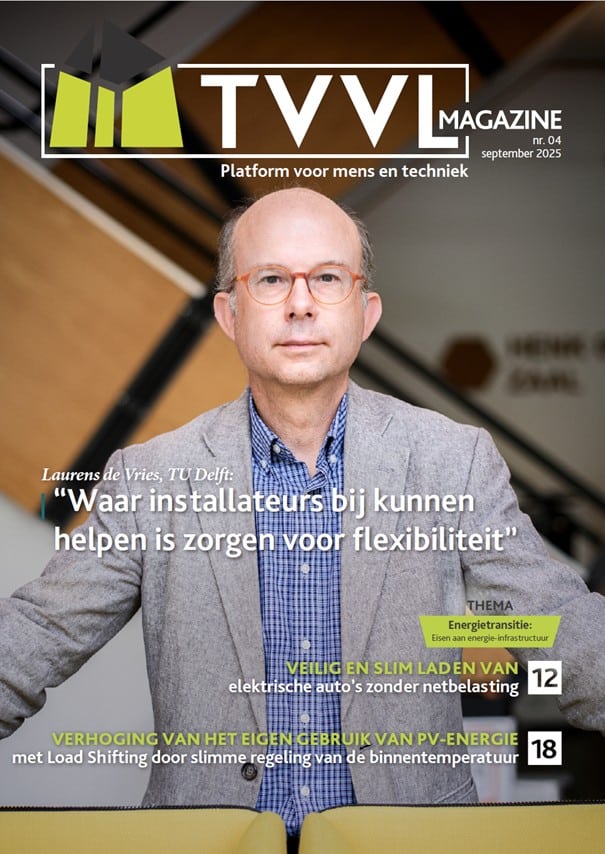
“What installers can contribute is ensuring flexibility.”
Interview with Laurens de Vries, Professor of Complex Energy Transitions at Delft University of Technology
by Tijdo van der Zee
The energy transition is under severe strain. The electricity grid is reaching capacity, sustainable gases are not yet widely available, and to top it all off, high-voltage grid operator TenneT issues increasingly urgent calls each year for measures to safeguard security of supply. Choices must be made about reliability, grid capacity, and the role of decentralized solutions. To his regret, Laurens de Vries, Professor of Complex Energy Transitions at Delft University of Technology, sees that politicians have failed to take these decisions in recent years. Meanwhile, the installation sector is in a position to take concrete, no-regret steps, especially when it comes to unlocking flexibility. “I can achieve far more with practical measures than with vague CO₂ targets for 2030 and beyond,” he stresses.
Article 2
Safe and Smart charging of Electric Cars Without Straining the Grid
By Dr. Marisca Zweistra, Project and Program Manager at ElaadNL
The electrification of mobility and heating is making a decisive contribution to a more sustainable energy system. Electricity is increasingly being generated from renewable sources. As fossil infrastructure is replaced, we are using the electricity grid much more intensively. This has greatly increased the urgency of developing system innovations that improve the efficiency of the existing grid and safeguard the stability of the future electricity supply.
The SmoothEMS with GridShield project, completed in May 2025, developed several innovations for managing charging sessions in a safe, efficient way—helping to ensure a smooth transition to 100% renewable energy. The project was a collaboration between ElaadNL, the University of Twente, Amperapark, Kropman, Mennekes, and a.s.r. Insurance, and received funding from the Ministry of Climate and Green Growth through the Netherlands Enterprise Agency’s Top Sector Energy program.
Article 3
Increasing PC Self-Consumption Through Load Shifting with Smart Indoor Temperature Control
By Zahra Tabatabaei (Faculty of Architecture, Eindhoven University of Technology), Twan van Hooff (Faculty of Architecture, Eindhoven University of Technology), Rick Kramer (Faculty of Architecture, Eindhoven University of Technology), Jan-Fokko Haan (Kropman Installation Technology), Kevin de Bont (OpenToControl), Paul Noom (Kropman Installation Technology).
Modern buildings equipped with PV panels often generate a surplus of electricity. This excess is usually fed back into the grid. But when grid capacity is insufficient—an increasingly common occurrence in the Netherlands—this causes congestion. Both exporting surplus electricity and importing power during peak demand periods are problematic.
In this context, Demand-Side Management (DSM), or demand-driven energy management, offers a promising approach. By shifting energy use over time, load shifting can align demand with peak summer PV production or help reduce winter peak loads. This boosts building flexibility and helps ease grid congestion.
The ASR office building in Utrecht, fully powered by electricity, is currently facing capacity constraints. Innovative methods are therefore essential to better match supply and demand. This research project explored the potential of load shifting, focusing on reducing winter peak demand and increasing summer PV self-consumption. Field tests in the building were combined with simulations in MATLAB-Simulink. The study demonstrated that intelligent indoor temperature control via the building management system can make a significant contribution.
Article 4
The New Energy Act Gives the Installation Sector a Contral Role in the Transition “Every Entrepreneur will become an energy manager.”
By Harmen Weijer, Chief Editor TVVL Magazine
The New Energy Act, which comes into force in 2026, marks a new era for energy use and management in the Netherlands. For entrepreneurs, it brings new obligations and responsibilities—but also opportunities. For the installation sector, it represents a chance to take center stage in accelerating the energy transition.
“We need to evolve even more from installer to advisor,” says Edwin Koers, Business Development Manager at Unica Building Services. “The energy transition will only succeed if we truly help entrepreneurs with their capacity planning.”
The New Energy Act, which comes into force in 2026, marks a new era for energy use and management in the Netherlands. For entrepreneurs, it brings new obligations and responsibilities—but also opportunities. For the installation sector, it represents a chance to take center stage in accelerating the energy transition.
“We need to evolve even more from installer to advisor,” says Edwin Koers, Business Development Manager at Unica Building Services. “The energy transition will only succeed if we truly help entrepreneurs with their capacity planning.”
Article 5
Grid Operators Challenge the Market to Devise Smarter, Faster Substation Connections
“We desperately need your brainpower.”
By Harmen Weijer, Chief Editor TVVL Magazine
To tackle the enormous challenge of grid congestion, the three major grid operators—Alliander, Enexis, and Stedin—launched a unique competition. The key question: who can deliver a smarter, faster, and simpler way to connect medium-voltage substations?
The result was a wave of innovations, new partnerships, and fresh perspectives. “We no longer want to solve everything ourselves. We urgently need the market’s creativity,” says Maartje Brans on behalf of the three operators.
Article 6
“Grid congestion forces entrepreneurs to innovate”
By Joop van Vlerken
For many companies, grid congestion is a major obstacle to expansion or sustainability efforts. But according to Croonwolter&dros, it is not a threat but an opportunity, says Werner Out, who leads the company’s efforts in this area. “Grid congestion is finally pushing entrepreneurs to invest in smart energy solutions. It’s not a problem to accept but an opportunity to seize.”
“Many entrepreneurs are on the waiting list,” says Werner Out, Commercial Manager at Croonwolter&dros. “A company wants to expand, make its buildings more sustainable, or construct something new—but there’s no capacity on the grid. For us, grid congestion isn’t a bottleneck. Customers are finally asking the right questions. The systems we build—energy management systems, thermal energy storage, batteries, solar panels—aren’t technically complex. They’ve been around for years. But only now are businesses truly willing to invest in them.”
According to Out, grid congestion is a wake-up call for companies that waited too long to adopt new technologies. “It makes painfully clear what you’ve been putting off. We don’t just help solve their problems—we also give them back a competitive edge. By becoming less dependent on grid operators, they gain a sense of freedom many entrepreneurs find liberating.”
Article 7
Plumbing Industry Brimming with Innovation
By Rob van Mil
The TVVL National Sanitary Technology Congress serves as an important annual benchmark for developments in the sector. This was again the case at the most recent edition, held May 26 at Theater De Flint in Amersfoort. With six plenary lectures and three parallel sessions to choose from, attendees had plenty of opportunities to update their knowledge. The wide range of topics highlighted that the plumbing industry is full of innovation and renewal.
“Safe sanitary installations are a basic necessity,” said conference chair Nick Post of Hydroloop in his opening remarks. “Our field is essential to ensuring safe drinking water, hygienic drainage, and—an increasingly important issue—effective management of heavy rainfall.”
Post emphasized that knowledge development, and especially knowledge sharing, are crucial in addressing these challenges. The TVVL Expert Group on Sanitary Technology plays a pivotal role here. Besides organizing the annual congress, its members, together with field experts, conduct numerous preliminary studies. More than 50 such studies have now been completed: over 30 on (hot) tap water, 16 on sewer systems. Perhaps most importantly, 29 of them have led to follow-up actions such as ISSO publications, NEN standards, further research, or training courses. One of these studies was presented in detail during the congress.
Article 8
Circularity in Installation Practice at Feenstra
“To make reuse attractive, a structures approach is needed.”
By Rooske Gaal and Rik Altena, Editorial Board Members of TVVL Magazine
Circularity is often discussed in the context of construction, but the installation sector is already making significant progress. We spoke with Ruben Philippo, Branch Manager at Feenstra.